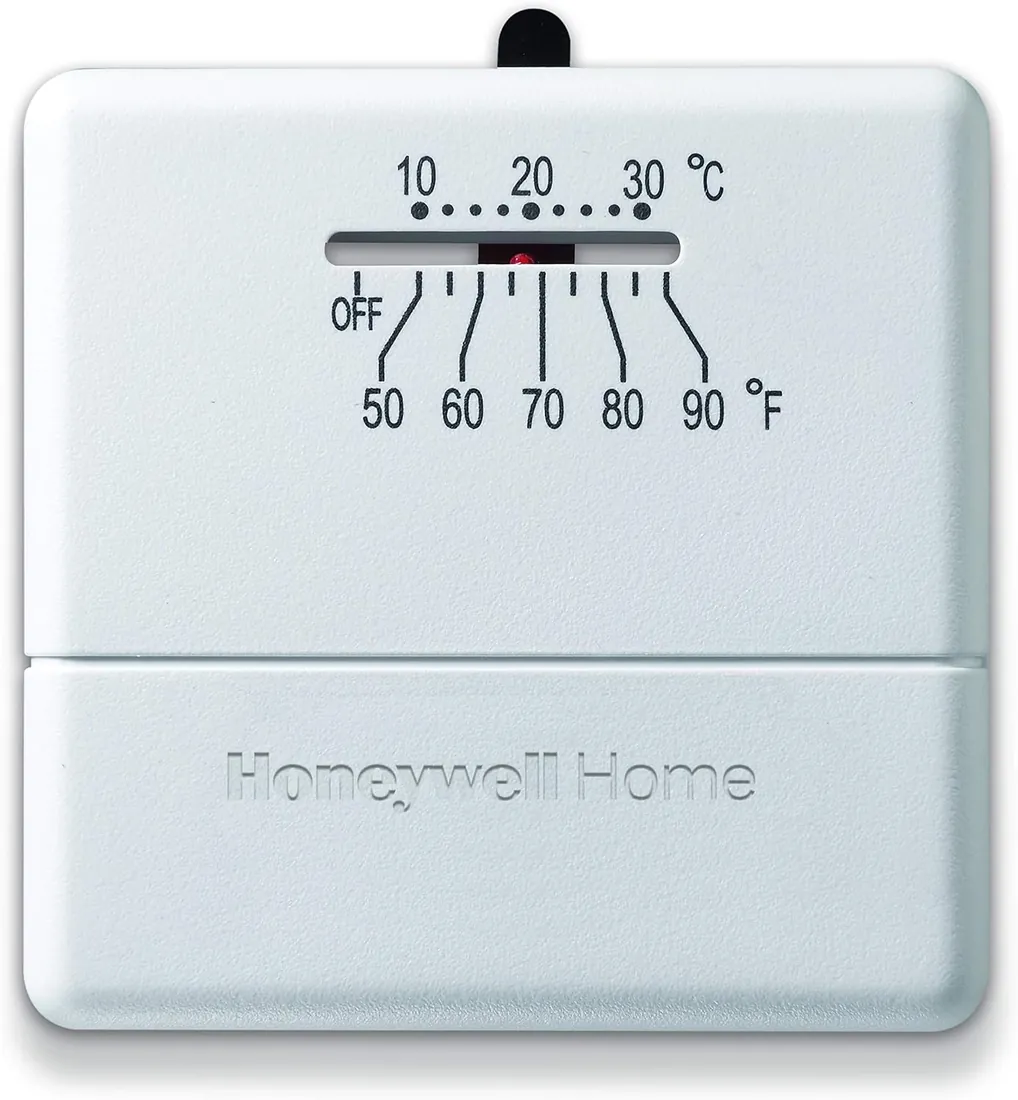
A standing-pilot gas heater makes its own electricity: a thermopile in the pilot flame produces a few hundred millivolts, enough to open the gas valve. The thermostat has to switch that tiny voltage reliably, so it must be rated for millivolt systems. Many 24-volt smart thermostats warn against it; the ecobee3 lite guide says not to connect it to millivolt systems.
How a millivolt system works
Many gas fireplaces, wall furnaces and floor furnaces have no connection to house power at all. A small pilot flame heats a thermopile, a stack of thermocouples, which generates a few hundred millivolts. When the thermostat closes its circuit, that voltage opens the main gas valve and the burner lights from the pilot. When the thermostat opens, the valve closes.
Because there's no transformer, there's no 24-volt R wire and no C wire. Usually two wires run to the thermostat, often labelled TH and TP/TH, or just connected to two screws on a simple wall thermostat.
Why most smart thermostats won't work
A 24-volt thermostat expects 24 volts AC to power its electronics and switch its relays. On a millivolt circuit it gets a fraction of a volt. The ecobee3 lite installation guide is explicit: the thermostat is designed for 24 V AC with a 2 A maximum current, and must not be connected to line-voltage or millivolt systems. Other makers say the same in their compatibility notes.
A millivolt thermostat uses a simple mechanical or battery-powered switch that doesn't draw power from the circuit. Some programmable models are rated for both 24-volt and millivolt systems; their listings say so. A few smart options exist, typically battery-powered with a relay suited to millivolt valves, and each states it.
How to recognise one
- A gas heater with a standing pilot that stays lit, and no plug or electrical connection.
- Two thin wires at the thermostat, often on terminals marked for the gas valve rather than R and W.
- A heater manual that names a 'millivolt' or 'thermopile' gas valve.
- A remote-control receiver or wall switch for a gas fireplace, rather than a central thermostat.
Choosing the thermostat
Look for the words 'millivolt' or 'compatible with millivolt systems' in the maker's statement. Our product pages show what each maker states under 'Works with systems'; when a listing doesn't mention millivolt, treat it as unconfirmed. Fireplace makers often specify the thermostat or remote kit they support; that specification takes priority.
| Thermostat | Systems (maker) | Power (maker) |
|---|---|---|
| Honeywell Home CT33A1009/N Millivolt Thermostat | Not stated | 750 mV |
A worked example
A wall furnace in a cabin has a pilot light, no electrical cord, and two wires running to an old dial thermostat. That's millivolt. A smart thermostat requiring 24 volts won't power on, and connecting it risks damage. A thermostat whose maker states millivolt compatibility, wired to the same two terminals, takes over the job. If the heater instead plugs into the wall and has a control board, it may be 24-volt after all: read its manual.
Safety
Not sure which system you have? Choose 'Millivolt' in the wiring checker to see only thermostats whose makers state millivolt support.